

By Stuart Chowning, Chief Strategy Officer, Telgoo5 · Last updated October 2026 · 5 min read
Key takeaways
An MVNO (mobile virtual network operator) is the brand that sells mobile service to customers. An MVNE (mobile virtual network enabler) provides the technology that runs the service, such as billing, activation and charging. An MVNA (mobile virtual network aggregator) buys network capacity from carriers in bulk and resells it to MVNOs. Together they let a brand launch mobile service without owning a network or building its own systems. Today, most MVNEs are cloud platforms that serve many MVNO brands at once.
In this guide: Quick definitions · How they work together · Comparison table · When you need an MVNE · Modern MVNEs · How to choose an MVNE · FAQ
Quick definitions: MVNO, MVNE and MVNA
• MVNO (mobile virtual network operator): a company that sells mobile service under its own brand using another carrier's network. It owns the customer relationship: plans, pricing, marketing and support.
• MVNE (mobile virtual network enabler): a technology partner that gives MVNOs the systems to run their service, including billing, real-time charging, SIM and eSIM activation, and customer care tools.
• MVNA (mobile virtual network aggregator): a wholesale partner that buys large amounts of network capacity from a carrier (MNO) and resells it in smaller packages to MVNOs that are too small to negotiate directly.
You'll also see the term MVNx, a catch-all for any of these virtual network players.
How MVNOs, MVNEs and MVNAs work together
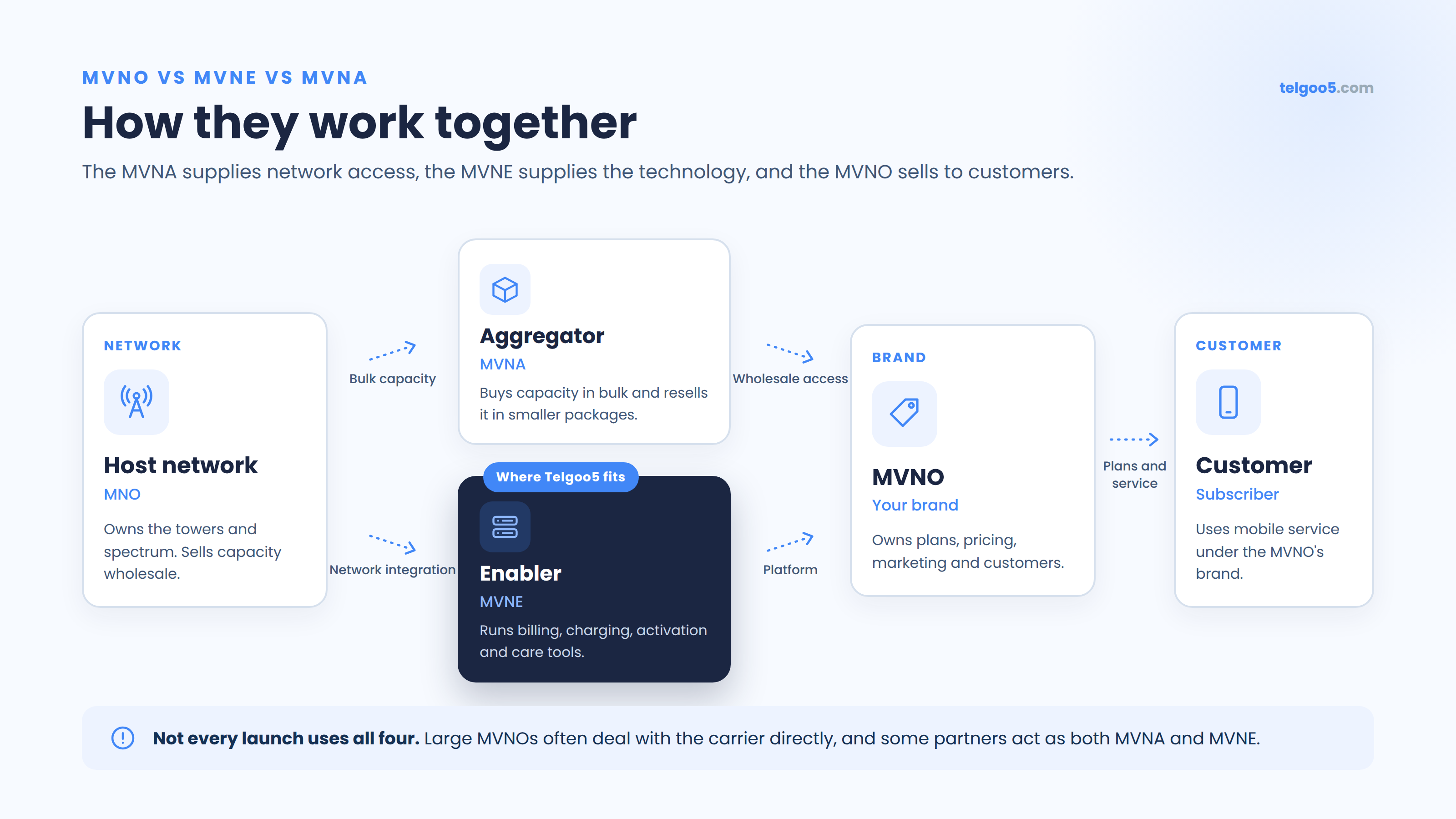
Think of launching a mobile brand like opening a store:
• The MNO (the carrier) owns the building: the towers, spectrum and network.
• The MVNA is the wholesaler: it buys network capacity in bulk and sells the MVNO the amount it needs.
• The MVNE provides the store systems: the checkout, inventory and customer accounts.
• The MVNO is the store brand customers see and buy from.
Not every launch uses all four. Large MVNOs often negotiate directly with a carrier and skip the MVNA. Some companies act as both MVNA and MVNE, offering network access and technology in one package.
MVNO vs MVNE vs MVNA: comparison table
| MVNO | MVNE | MVNA |
Role | Mobile brand | Technology partner | Wholesale partner |
Main customers | Consumers and businesses | MVNOs (and sometimes MVNAs and carriers) | MVNOs |
What it provides | Plans, pricing, marketing, support | Billing, charging, activation, customer care tools | Network capacity in smaller packages |
Relationship with the carrier | Directly or through an MVNA | Technical integration with the network | Bulk wholesale agreement |
How it makes money | Subscriber plans | Platform and service fees | Wholesale margin |
When do you need an MVNE?
Almost every MVNO needs MVNE capabilities. The question is whether you build them or partner for them. An MVNE makes sense when:
• You want to launch fast. Building billing, charging and carrier integrations in-house takes a long time. With an MVNE, a new brand can launch within weeks.
• Telecom isn't your core business. Banks, retailers and broadband providers want to offer mobile without hiring a telecom engineering team.
• You want predictable costs. Platform fees replace a large upfront build.
• You plan to change plans often. A good MVNE lets you launch new plans and promotions yourself, without a development project.
The main reason to build your own systems is scale: very large operators with unique needs may want full control of their technology.
Modern MVNEs: cloud-based and multi-tenant
Older MVNEs ran on-premise systems that were slow to change. Today's MVNEs look different:
• Cloud and SaaS. The platform runs in the cloud and is updated continuously, so MVNOs get new features without upgrade projects.
• Multi-tenant. One platform serves many MVNO brands, each with its own plans, customers and branding, kept separate from the others.
• Real-time. Usage is charged as it happens, so customers see live balances and brands avoid revenue loss.
• API-first. Brands can build mobile service into their own apps, which is what makes embedded and fintech MVNOs possible.
"The MVNE used to be a back-office vendor. Now it's the platform a brand's whole mobile business runs on. The best MVNEs let a brand go from idea to live subscribers in weeks, then change plans as fast as the market does." Stuart Chowning, Chief Strategy Officer, Telgoo5
How to choose an MVNE
When comparing MVNE partners, ask:
1. Which host networks are you integrated with? Pre-built carrier integrations save months.
2. How long does a launch take? Ask for real timelines from recent launches.
3. Can we change plans and pricing ourselves? You shouldn't need a support ticket to launch a promotion.
4. Do you support eSIM and in-app activation? This is now expected by customers.
5. Is charging real time? Real-time charging prevents revenue loss and supports prepaid plans.
6. Do you handle tax and compliance? Telecom taxes and regulations are complex and change often.
7. How is the platform priced as we grow? Make sure costs stay predictable as you add subscribers.
How Telgoo5 works as an MVNE
Telgoo5 is a cloud-native MVNE platform used by 75+ MVNOs. It is integrated with top carriers and gives each brand billing, real-time charging, eSIM activation, customer care and self-service on one multi-tenant platform. Brands keep full control of their plans and customer experience, while Telgoo5 runs the technology underneath. See Telgoo5's BSS solutions.
Frequently asked questions
What is an MVNE?
An MVNE (mobile virtual network enabler) is a technology partner that provides MVNOs with the systems to run mobile service, such as billing, real-time charging, SIM and eSIM activation, and customer care tools.
What is an MVNA?
An MVNA (mobile virtual network aggregator) buys network capacity from carriers in bulk and resells it to smaller MVNOs that can't meet a carrier's volume requirements on their own.
Does every MVNO need an MVNE?
Every MVNO needs MVNE capabilities, but not every MVNO uses a partner. Most new brands work with an MVNE to launch faster, while some large operators build their own systems.
Can one MVNE serve multiple MVNOs?
Yes. Modern MVNEs are multi-tenant, so one platform serves many MVNO brands, each with its own plans, customers and branding kept separate.
Looking for an MVNE partner? Talk to our team
About the author: Stuart Chowning is Chief Strategy Officer at Telgoo5. Stuart is an industry and thought leader with years of experience in the entire MVNO supply chain.
Related: What Is an MVNO? · How to Start an MVNO · BSS vs OSS