

For an Internet Service Provider (ISP), adding mobile connectivity transforms a basic fixed broadband pipe into a high-retention, convergent communication service. The primary challenge is not market demand—it is the operational orchestration of mobile services across existing BSS, rating engines, subscriber management, automated provisioning, and tier-1 support desks.
A targeted 90-day implementation focuses on four controlled stages: Planning, Integration, Testing, and Controlled Launch. The core objective is proving one complete, zero-defect mobile-bundling workflow before scaling the retail catalog.
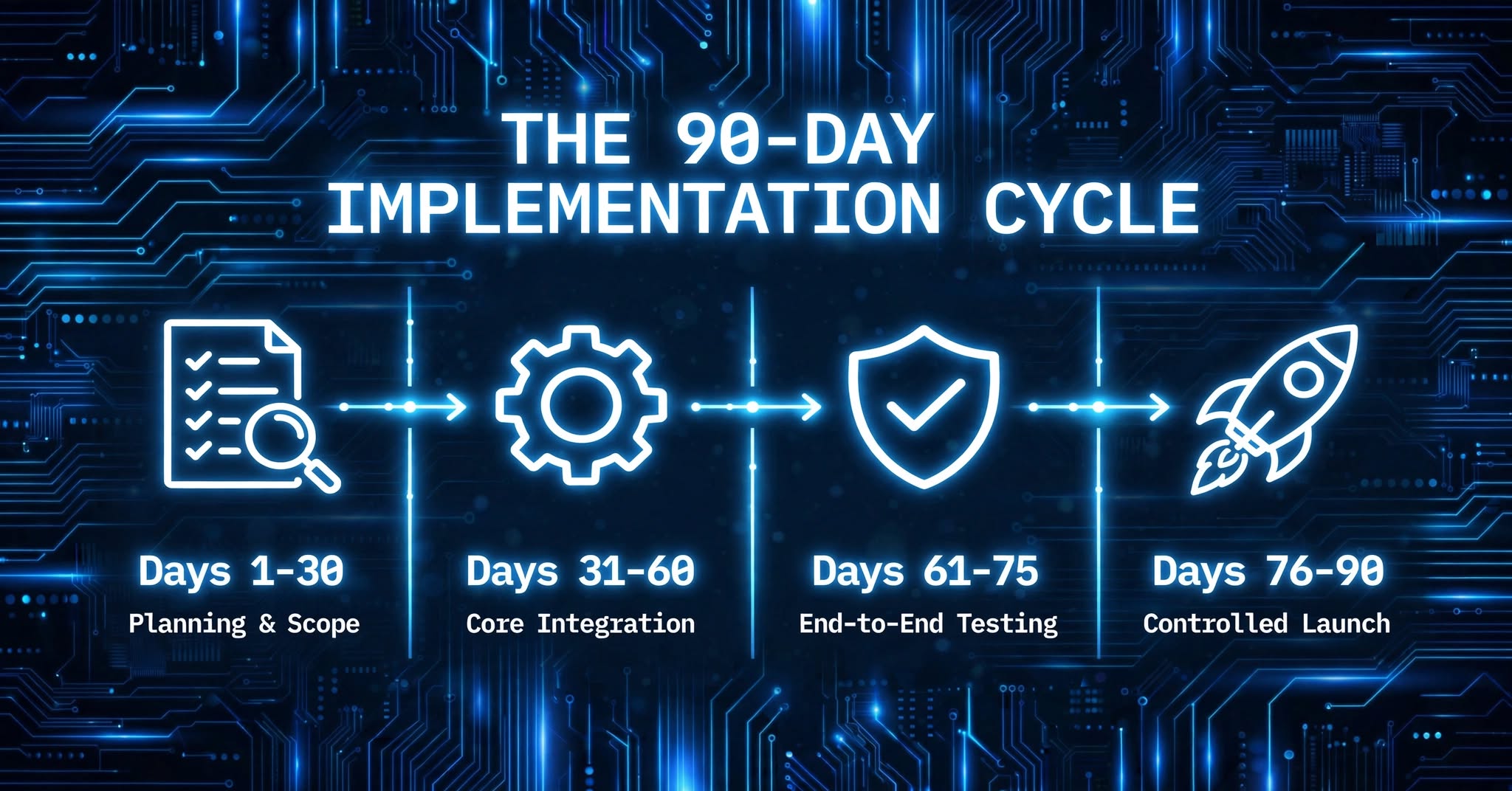
Phase 1: Planning (Days 1–30)
The opening 30 days establish the commercial boundaries, regulatory foundation, and unit economics of the bundle.
Defining the Initial Bundle
Keep the introductory product catalog deliberately lean to minimize technical overhead:
Primary Anchor: A baseline Broadband + Mobile bundle where an active broadband subscriber adds a single primary mobile line on the same unified invoice.
Secondary Options: Tiered family plans with pooled allowances or small-business connectivity packages (fixed line + backup mobile connectivity).
Catalog Constraints: Every plan must have locked configurations for data allowances, voice/SMS caps, fair usage policies (FUP), tax schedules, auto-renewal cycles, and cancellation rules.
These commercial definitions translate directly into technical charging tables inside the BSS and Online Charging System (OCS).
Calculating Subscriber Economics
Retail pricing must be engineered backwards from total wholesale exposure. The margin model must incorporate:
Wholesale Network Charges: Data per-GB transit rates, voice termination, and SMS unit charges.
Fulfillment Costs: Physical SIM card logistics, eSIM profile onboarding costs, and KYC verification overhead.
Financial Overheads: Payment gateway processing fees, regional telecom regulatory fees, and localized communication taxes.
Operational Buffer: Tier-1 and Tier-2 support desk costs per active subscriber.
Critical Guardrail: Model customer profitability against heavy-usage thresholds. A bundle showing 35% margin at 8 GB/month can collapse into negative margin if user behavior averages 25 GB/month under wholesale unmetered assumptions.
Selecting the Operating & Regulatory Model
Confirm wholesale mobile connectivity agreements and legal operating structures early. As outlined in our guide on how to successfully launch an MVNO, selecting the right wholesale partner is the operational foundation of your business model:
Wholesale Partnership: Evaluate whether integration happens via a direct Host Mobile Network Operator (MNO), a Mobile Virtual Network Aggregator (MVNA), or an established MVNE operating model.
Regulatory Compliance: Align technology plans with local licensing bodies. For example, operators entering the Indian market must secure authorizations under the unified Virtual Network Operator (VNO) framework operating under the Telecommunications Act.
Phase 2: Systems Integration (Days 31–60)
The middle phase establishes seamless API connectivity across the IT and network architecture. Core Rule: A single customer order must trigger synchronized commercial and network actions across the entire stack.
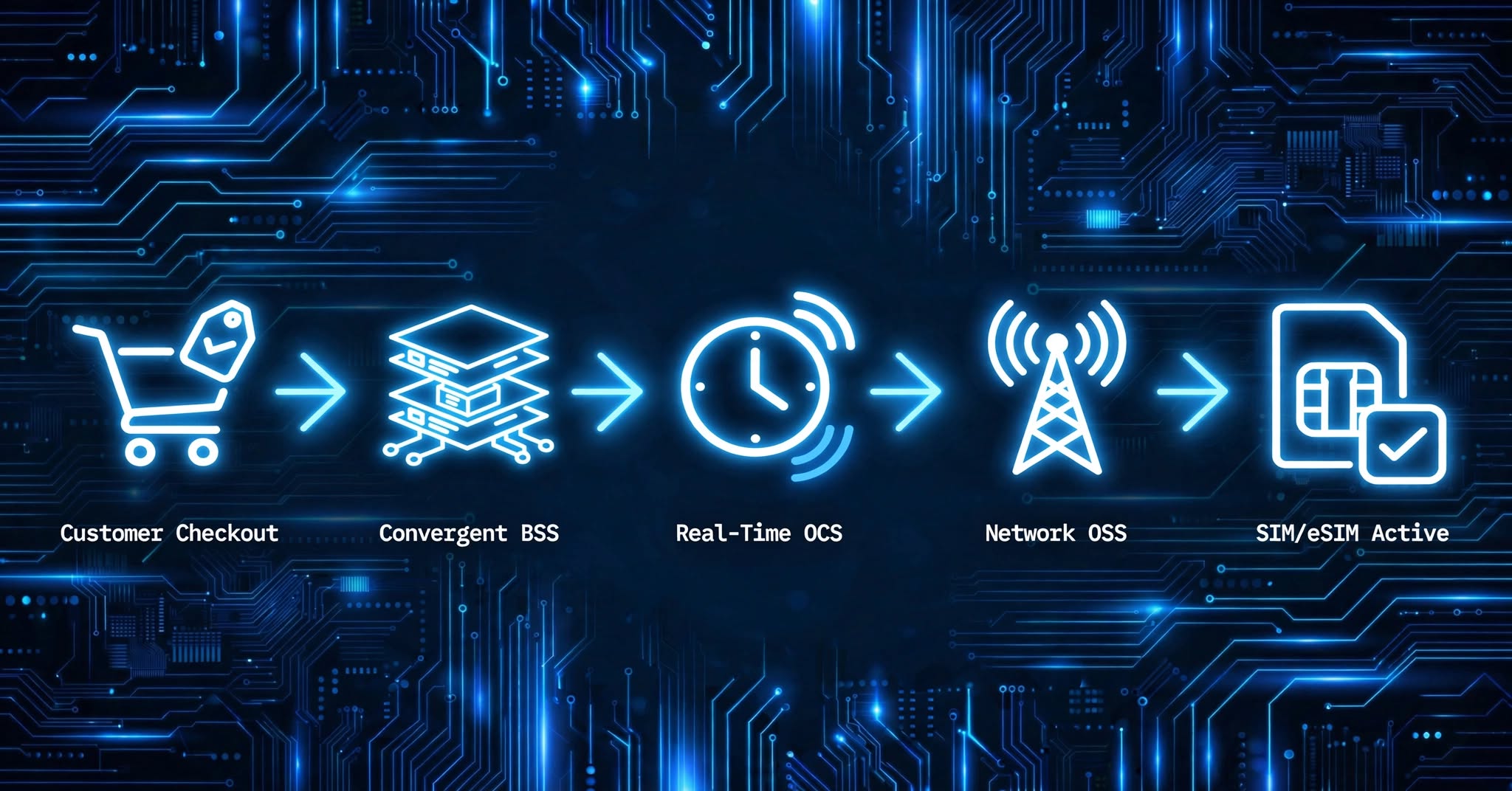
Business Support Systems (BSS)
The BSS serves as the commercial master:
Consolidates account identity, subscription lifecycles, catalog rules, and unified invoicing. For a structural breakdown of these architectural layers, review our analysis on BSS and OSS as the backbone of telecom.
Prevents data fragmentation by housing both fixed broadband and mobile services under a single customer account record within a modern BSS architecture.
Online Charging System (OCS)
Mobile usage requires real-time credit control and rating:
Intercepts usage events to enforce real-time rate calculation, shared quota depletion, dynamic top-ups, and speed throttling.
Deploying a real-time convergent billing engine ensures prepaid, postpaid, broadband, and mobile transactions settle against a single balance.
Synchronizes instantly with the central product catalog to eliminate pricing mismatches.
Operations Support Systems (OSS)
The OSS converts orders into operational network services:
Receives validated orders from the BSS and orchestrates downstream provisioning calls to the mobile core or MVNE gateway.
Enforces strict state integrity: an order is never marked complete until network activation returns a successful response code.
SIM and eSIM Lifecycle Management
Automate subscriber identity workflows:
Physical SIMs: Inventory tracking, warehouse barcode scanning, dealer allocations, and SIM swap/replacement workflows.
eSIM Provisioning: Direct API integration with SM-DP+ servers, automated QR code delivery, and in-app profile downloads that support next-gen virtual telecom services.
Phase 3: Comprehensive Testing (Days 61–75)
Silo testing is insufficient; testing must validate bidirectional data flow across the complete subscriber journey.
1. Order-to-Activation Workflow
Validate the automated handoff sequence:
Customer selects bundle in self-care portal.
BSS creates customer order and provisions subscription entity.
Inventory system assigns MSISDN and ICCID/eSIM profile.
OSS issues provisioning request to wholesale mobile gateway.
Network core confirms activation; BSS activates subscription billing.
Failure Validation: Inject synthetic network errors during SIM provisioning. The BSS must gracefully fail, rollback commercial state, and avoid creating active billing accounts for unprovisioned lines.
2. Usage-to-Charging Validation
Simulate live traffic across network boundaries:
Run concurrent sessions of 4G/5G data, VoLTE voice calls, and domestic/international SMS.
Confirm that balance deductions, shared pool depletion, and zero-rated traffic match OCS configurations with zero rounding discrepancies.
3. Charging-to-Billing Integrity
Verify financial reconciliation:
Push rated event records (CDRs) into the monthly billing run.
Audit invoice generation for bundle discounts, prorated plan upgrades, regional taxation accuracy, and payment gateway capture.
4. Unified Support Interface Verification
Eliminate operational friction for front-line support:
Verify customer service representatives (CSRs) have unified dashboard access displaying broadband connection metrics, mobile line status, SIM/eSIM identifiers, remaining quota balances, and open support tickets on a single screen.
Phase 4: Controlled Production Launch (Days 76–90)
Roll out mobile services using a staged canary deployment model rather than an unconstrained public launch.
Pre-Launch Production Checklist
[ ] BSS-to-OSS provisioning APIs tested under production concurrency limits.
[ ] Real-time OCS rating rules active and verified against wholesale tariff rates.
[ ] Production eSIM SM-DP+ and physical SIM activation flows validated live.
[ ] Payment gateway webhooks configured with automated retry schedules.
[ ] Telecom tax configurations, municipal cesses, and statutory fee engines signed off.
[ ] Support desk trained on standard operating procedures for SIM swaps and activation failures.
[ ] Automated alerting active for provisioning timeouts and rating drops.
Critical Operational Metrics
Monitor the initial cohort through real-time operational telemetry:
Activation Success Rate: Target >99.2% zero-touch completion.
First-Bill Accuracy: Target 100% dispute-free invoices.
Provisioning Latency: Target <60 seconds for eSIM delivery.
Average Margin Per User (AMPU): Realized margin after wholesale network usage deductions.
Support Contact Ratio: Target <5% of new activations generating support tickets.
Target Architecture & Implementation Timeline
Enterprise Architecture Functional Mapping
Function | Operational Purpose | Key System Requirement |
CRM | Unified customer & service hierarchy | Single customer ID across fixed & mobile lines |
Product Catalog | Single source of truth for commercial rules | Unified rating logic for bundles, add-ons & FUP |
Order Management | Multi-system order decomposition | Transactional rollback on activation failure |
Convergent BSS | Account management & subscription billing | Unified invoicing for broadband and mobile |
Real-Time OCS | In-flight rating, balance tracking & throttling | Sub-millisecond latency for session charging |
Billing Engine | Invoice calculation, taxes & collections | Support for split billing and unified payment |
OSS Provisioning | Interface with MNO/MVNE core networks | Automated eSIM generation & HLR/HSS sync |
SIM Management | ICCID/eSIM inventory & lifecycle events | Integrated with warehouse & SM-DP+ platforms |
Analytics Engine | Usage patterns, margin analysis & churn | Real-time wholesale cost vs. retail revenue |
90-Day Execution Schedule
Milestone | Window | Primary Deliverables |
Phase 1: Planning | Days 1–30 | Finalized bundle definitions, wholesale cost modeling, regulatory filings, catalog specs. |
Phase 2: Integration | Days 31–60 | API integration between BSS, OSS, OCS, payment gateways, and SIM inventory engines. |
Phase 3: Testing | Days 61–75 | End-to-end sandbox testing: order-to-activation, real-time usage, billing runs, and CSR tools. |
Phase 4: Launch | Days 76–90 | Controlled rollout to initial customer pilot group, KPI monitoring, and operational sign-off. |
Frequently Asked Questions
Can an ISP launch an MVNO in 90 days?
Yes, provided the project scope remains focused on a minimal viable catalog and leverages API-ready convergent BSS/OSS platforms. Timelines expand if the ISP attempts custom core network buildouts or encounters protracted wholesale/regulatory negotiations.
What should an ISP launch first?
An ISP should launch a simple Broadband + Mobile single-line bundle. Restricting the initial launch to one or two well-defined plans keeps charging matrices, provisioning workflows, and billing reconciliation simple during early operations.
Does an ISP need a separate BSS for mobile?
No. Operating separate BSS platforms creates split billing, siloed customer accounts, and higher operational overhead. A convergent BSS allows broadband and mobile services to be managed, billed, and serviced through a unified operational interface.
Why is an OCS mandatory for MVNO operations?
An Online Charging System (OCS) enables real-time session tracking and credit enforcement. Without an OCS, ISPs risk significant revenue leakage from postpaid unmetered data overages or delayed offline mediation records.
What is the single biggest integration failure point?
The most critical failure point is state desynchronization between commercial systems (BSS) and network systems (OSS). If an API timeout leaves an account marked "active" in the billing system while the network failed to provision the SIM, billing disputes and immediate churn will follow.
Operational Roadmap
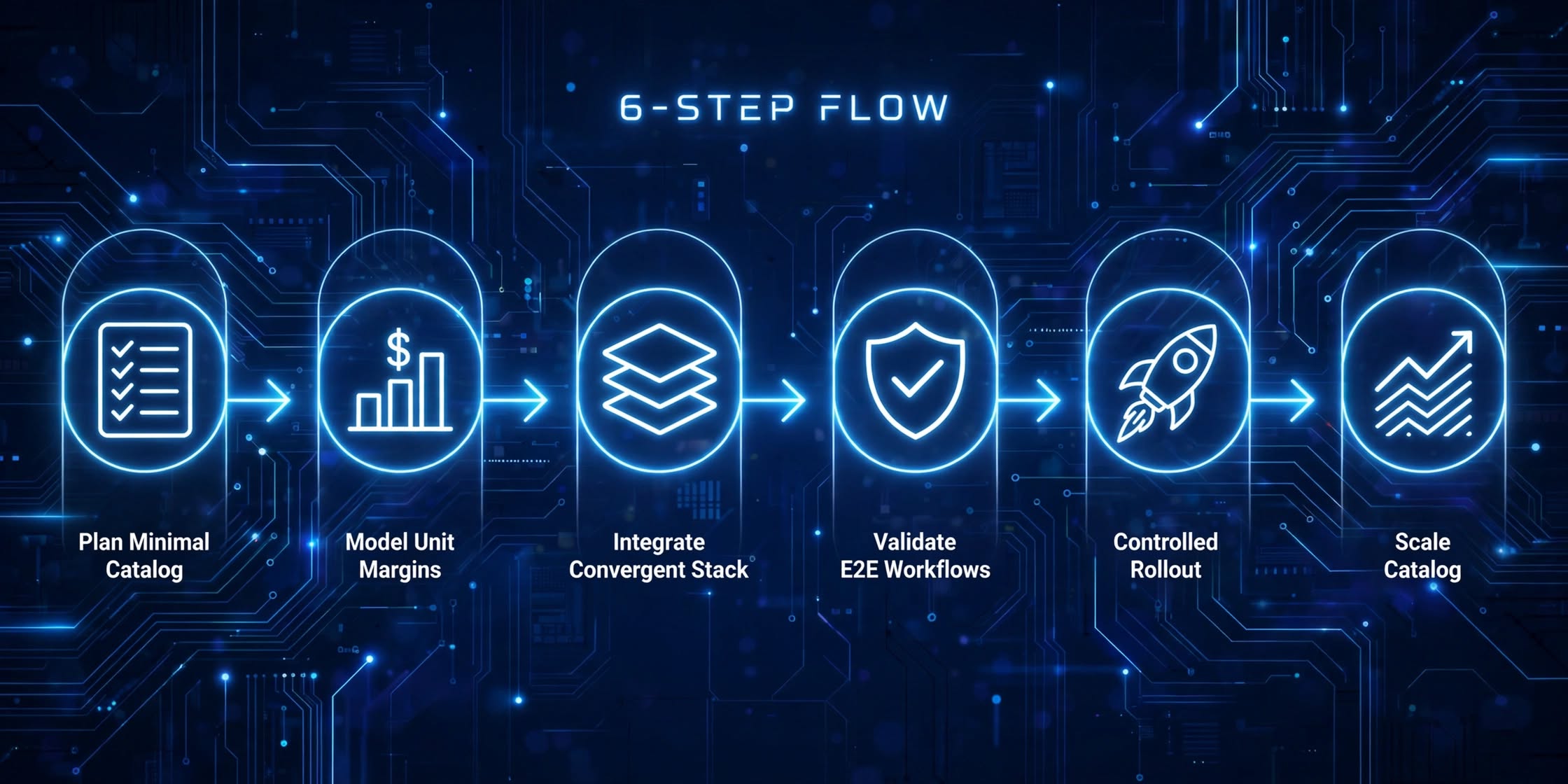
Lock the catalog: Restrict offerings to high-margin, straightforward fixed-mobile bundles.
Synchronize the core: Unify commercial actions (BSS) with network actions (OSS/OCS).
Validate before scale: Use a controlled subscriber pilot to stress-test billing accuracy and provisioning reliability before opening public sales channels.