
By Stuart Chowning, Chief Strategy Officer, Telgoo5 · Last updated October 2026 · 5 min read
Key takeaways
An MVNO (mobile virtual network operator) is a company that sells mobile service under its own brand using another carrier's network. MVNOs range from simple resellers to full operators with their own core network, and today they are launched by cable companies, retailers, banks, tech brands and businesses, not just telecom companies. Most make money by buying network capacity wholesale and selling plans at a margin, or by using mobile to keep their core customers loyal.
In this guide: What is an MVNO? · How MVNOs work · Types of MVNOs · Business models · Benefits and challenges · Examples · FAQ
What is an MVNO?
MVNO stands for mobile virtual network operator. It's a mobile service provider that doesn't own the cell towers or radio spectrum its customers use. Instead, it rents capacity on a virtual mobile network from a mobile network operator (MNO), the companies that own the physical network.
In the US, the three national MNOs are AT&T, Verizon and T-Mobile. Those are carriers, not MVNOs. Many of the MVNO carriers you see advertised run on one of their networks, but set their own brand, pricing, plans and customer experience.
How MVNOs work
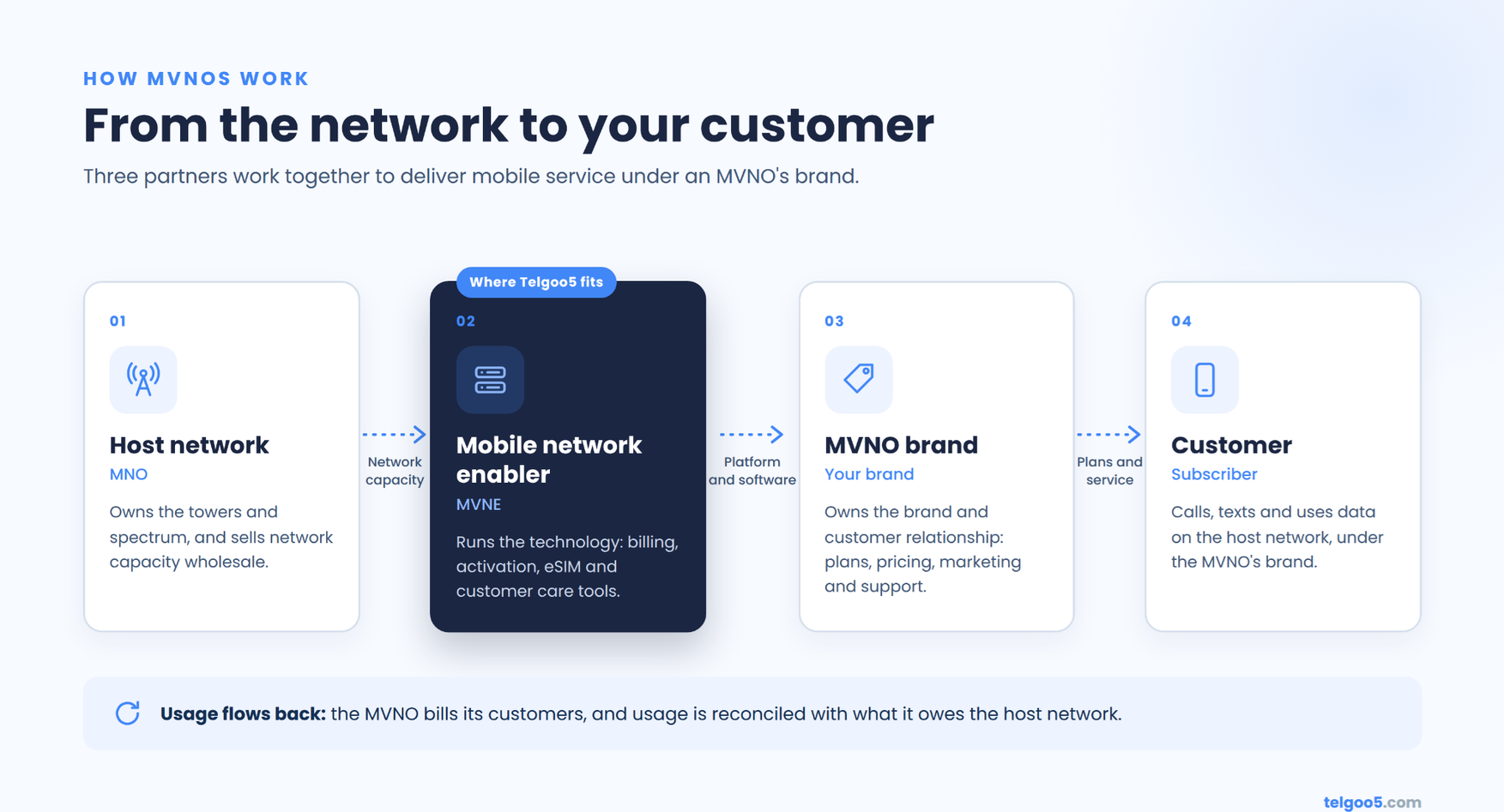
An MVNO network typically involves three players:
• The host network (MNO) owns the towers and spectrum and sells capacity wholesale.
• The mobile network enabler (MVNE) provides the technology to run the service, such as billing, activation, eSIM provisioning and customer care tools. Some MVNOs build this themselves; most partner with an MVNE.
• The MVNO owns the brand and the customer relationship. It designs plans, sets prices, markets the service and supports its subscribers.
When a customer makes a call or uses data, the traffic travels over the host network. The MVNO's systems track that usage, bill the customer and reconcile what it owes the host network.
Types of MVNOs
There are two useful ways to group MVNOs: by how much of the operation they run, and by who is launching them.
By how much they run
Type | What they run | What the partner runs |
Branded reseller | Brand, marketing and sales | Almost everything else |
Light MVNO | Brand, plans, pricing and customer care | Core network and much of the technology |
Full MVNO | Its own core network, SIMs and systems | Radio network only |
Most new brands start as a light MVNO, which balances control with speed to market.
By who is launching them
• Brand and embedded MVNOs. Retailers, tech companies and consumer brands add mobile service to their product, often inside their own app.
• Fintech and banking MVNOs. Banks and payment apps offer mobile plans to increase engagement and give customers another reason to stay.
• Cable and broadband MVNOs. Internet providers bundle mobile with home internet to reduce churn and offer one bill.
• Enterprise and MSP MVNOs. Managed service providers and businesses run private label mobile services for their employees, devices or business customers.
• Niche and community MVNOs. Brands built around a specific audience, such as international callers, seniors, students or a local region.
MVNO business models
The most common MVNO business models are:
• Wholesale margin. Buy network capacity at wholesale rates and sell retail plans at a markup. This is the classic model and depends on volume and low acquisition costs.
• Bundling. Add mobile to an existing service, such as broadband or TV. Mobile may earn a thin margin on its own, but customers with bundles are less likely to leave.
• Loyalty and engagement. Offer mobile as part of a membership, rewards program or banking app. The goal is retention and more customer data, not just plan revenue.
• B2B and enterprise. Sell managed mobile service to businesses, often alongside devices, IoT connectivity or IT services.
Many successful MVNOs combine more than one of these models.
Benefits and challenges of being an MVNO
Benefits | Challenges |
No need to build or own a network | Thin margins on plan revenue alone |
Launch within weeks with an MVNE | Dependence on the host network's terms |
Own the brand and customer relationship | Customer acquisition can be expensive |
Flexible plans for a specific audience | Compliance, taxes and number porting to manage |
"The MVNOs that last are the ones that know exactly why their customers would buy mobile from them. The network is the same for everyone. The brand, the experience and the reason to stay are what you actually control." Stuart Chowning, Chief Strategy Officer, Telgoo5
Real-world MVNO examples
• Cable and broadband: Xfinity Mobile (Comcast) and Spectrum Mobile (Charter) bundle mobile with home internet, running on Verizon's network.
• Carrier-owned brands: Visible runs on Verizon's network, and Mint Mobile runs on T-Mobile's network. Both operate as MVNO brands owned by their host carrier.
• Tech brands: Google Fi offers mobile service tied closely to Google's devices and apps.
• Retail: Tesco Mobile in the UK, a joint venture between Tesco and O2, links mobile plans to its Clubcard loyalty program.
• Niche audiences: Consumer Cellular focuses on older adults, and Lycamobile focuses on international calling.
After supporting 75+ MVNOs, Telgoo5 sees the same pattern across every type: the brands that grow fastest start with an audience they already serve well.
Frequently asked questions
What does MVNO stand for?
MVNO stands for mobile virtual network operator: a company that sells mobile service under its own brand on another carrier's network.
How do MVNOs make money?
Most MVNOs buy network capacity wholesale and sell plans at a margin. Others use mobile to drive loyalty or bundles, earning more from customers who stay longer.
What are the types of MVNOs?
By setup, MVNOs are branded resellers, light MVNOs or full MVNOs. By who launches them, common types include brand and embedded, fintech, cable and broadband, enterprise and niche MVNOs.
Do MVNOs own network infrastructure?
No. MVNOs don't own cell towers or spectrum. Full MVNOs may run their own core network, but they still rely on a host carrier's radio network.
What is the difference between an MVNO and a carrier?
A carrier (MNO) owns and operates the physical network. An MVNO rents capacity on that network and focuses on the brand, plans and customer experience.
Thinking about launching your own mobile brand? Talk to our team