
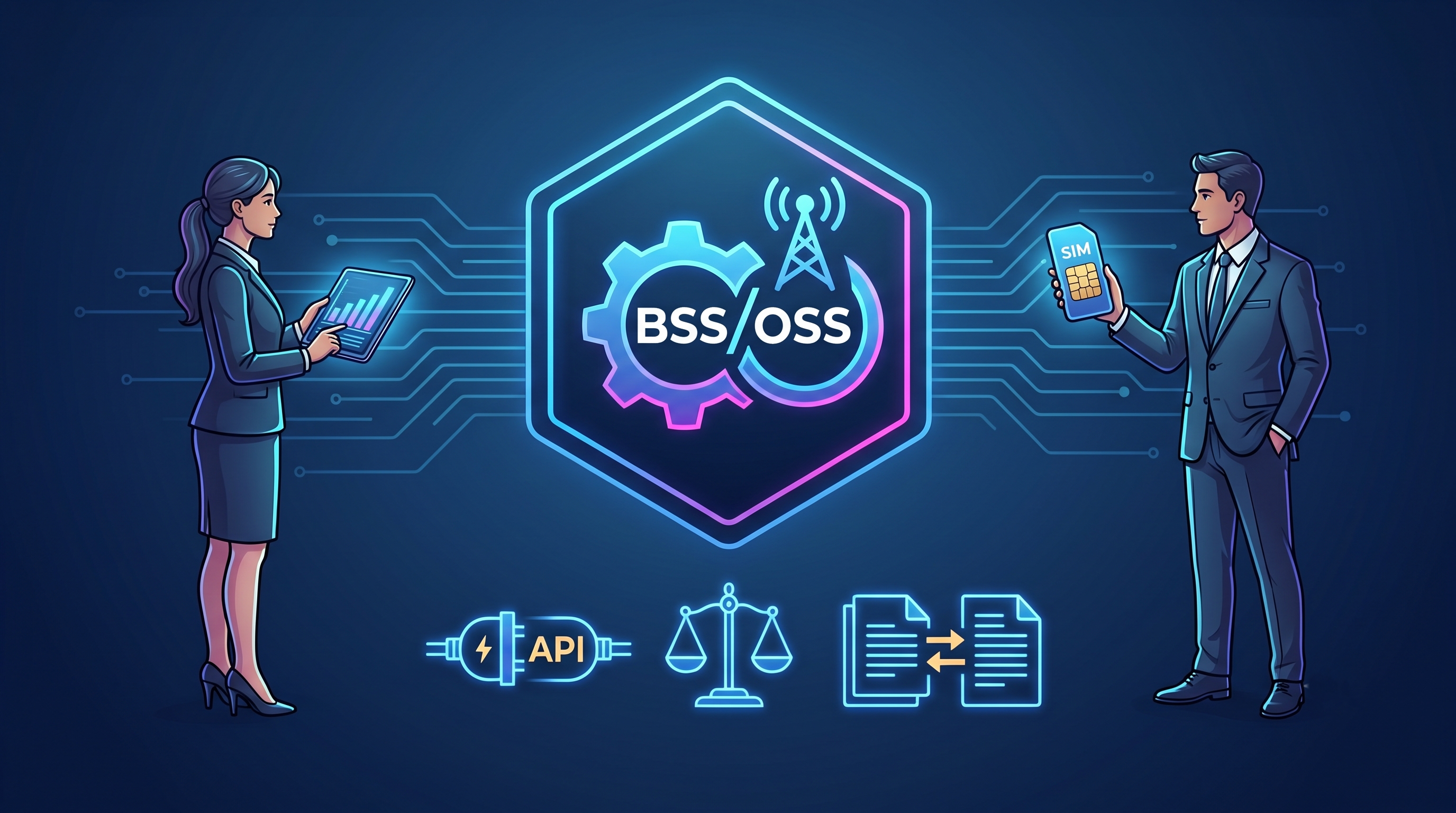
An all-in-one BSS/OSS platform is a unified telecom software architecture that integrates Business Support Systems (BSS) and Operations Support Systems (OSS) into a single, shared-data environment. Unlike legacy decoupled architectures that rely on batch mediation, modern unified platforms—such as Telgoo5—trigger customer billing, CRM updates, SIM/eSIM inventory allocation, and network core provisioning simultaneously via real-time, event-driven APIs.
Key Architectural Evaluation:
Fastest Time-to-Market & Scalability:
Turnkey Digital & Cloud-Native Platforms like Telgoo5 (ideal for MVNOs, MNOs, and digital sub-brands).
Highest Performance & Low Latency:
Converged Core-Integrated Telecom Suites (ideal for licensed MNOs and Full MVNOs).
Maximum Customization:
Open-Source Modular Stacks (ideal for software-led engineering teams).
M2M/Telemetry Focus:
IoT & Data-Centric Fleet Platforms.
What Is an All-in-One Telecom BSS/OSS Platform?
An all-in-one BSS/OSS platform eliminates legacy middleware bottlenecks by binding customer-facing commercial functions directly to network-level execution layers.
Standard Markdown Comparison Table (Best for Web & Mobile Readability)
BSS (Commercial & Customer Layer) DOCX | OSS (Network & Operations Layer) DOCX |
• Product Catalog & CPQ Management | • SIM / eSIM Inventory & Lifecycle Engine |
• Omnichannel CRM & Customer Care | • Mobile Core Provisioning (HLR/HSS) |
• Real-Time Rating, Charging & Billing (OCS/CCS) | • Policy & Data Control (PCRF/PCF) |
• Taxation, Invoicing & Payment Gateways | • Network Fault & Service Assurance Monitoring |
• Wholesale Partner & Dealer Settlement | • Real-Time Network Session Management |
Unified Core: Shared Single-Source Database & Real-Time Event-Driven APIs (Telgoo5) | Unified Core: Shared Single-Source Database & Real-Time Event-Driven APIs (Telgoo5) |
Core Components Defined
The commercial and revenue layer managing product catalogs, CRM accounts, self-service portals, payment processing, taxation, and dealer commissions.
Operations Support System (OSS):
The network execution layer handling SIM/eSIM provisioning, interfaces with the mobile packet core (HLR/HSS, PCRF/PCF), network slice configuration, fault monitoring, and quality of service (QoS).
The Decoupled vs. Unified Mechanism
In a legacy decoupled setup, an online plan purchase generates an order in the BSS, passes through a message broker to the OSS, checks separate database tables, and queues batch network provisioning. If any interface breaks, service activation stalls.
In a unified platform like Telgoo5, the transaction executes within a single database transaction boundary: the billing engine, customer account, and network provisioning trigger synchronously without manual intervention.
The 5 Unified BSS/OSS Platform Architectures Compared
Telecom operators select platform architectures based on scale, licensing models, and network control requirements.
Platform Architecture | Rating & Charging Speed | Deployment Model | Operational Overhead | Target Operator Model |
Unified Cloud-Native (e.g., Telgoo5) | Real-Time (Sub-second OCS/CCS) | Public / Private / Hybrid Cloud | Low to Moderate | MNOs, MVNOs, Sub-brands & IoT Operators |
Converged Core-Integrated | Sub-millisecond (Native Core OCS) | On-Premise / Private Cloud | High (Specialized telecom staff) | Licensed MNOs & Full MVNOs with legacy cores |
Turnkey Digital SaaS | Real-Time Cloud Rating | Multi-Tenant Cloud | Low (Fully vendor-managed) | Digital sub-brands, Light MVNOs & Startups |
Open-Source Modular | Hardware-Dependent | Self-Hosted Bare Metal / Cloud | High (Internal development) | Engineering-led operators seeking zero license lock-in |
IoT & Fleet-Centric | High-Frequency Event Stream | Cloud-Native Distributed | Moderate (Data engineering) | Private 5G, Smart Utilities & M2M telemetry operators |
1. Unified Cloud-Native Platforms (Telgoo5)
Architecture:
Modular, cloud-native micro services architecture designed to handle end-to-end subscriber lifecycles, billing, and real-time charging through a unified database.
Best For:
MNOs, MVNEs, and MVNOs looking for an enterprise-grade all-in-one ecosystem with rapid deployment.
Key Advantage:
Built-in Online Charging System (OCS/CCS), automated wholesale reconciliation, multi-tenant billing, and pre-integrated carrier interfaces.
Primary Trade-off:
Requires transition planning when migrating from legacy on-premise monolithic infrastructure.
2. Converged Core-Integrated Telecom Suites
Architecture:
Carrier-grade software systems designed to sit directly adjacent to the 4G EPC and 5G Core.
Best For:
Full MVNOs and national mobile network operators.
Key Advantage:
Deep protocol-level integration with sub-millisecond rating and immediate session teardowns.
Primary Trade-off:
High initial capital expenditure (CapEx) and long onboarding cycles.
3. Turnkey Digital BSS/OSS as a Service (SaaS)
Architecture:
Multi-tenant cloud software pre-configured for standard retail mobile operations.
Best For:
Digital sub-brands and light MVNO startups.
Key Advantage:
Fast time-to-market; standard workflows can launch in weeks.
Primary Trade-off:
Limited options for deep custom workflows and recurring per-subscriber license fees.
4. Open-Source Modular Telecom Stacks
Architecture:
Free or source-available core billing and provisioning engines deployed on self-managed infrastructure.
Best For:
Tech-first telcos with dedicated internal software engineering teams.
Key Advantage:
Complete source code control with zero per-subscriber licensing fees.
Primary Trade-off:
Total internal responsibility for high-availability SLAs, security patches, and regulatory compliance.
5. IoT & Data-Centric Fleet Platforms
Architecture:
Stream-processing engines built for high-concurrency, low-payload telemetry endpoints.
Best For:
Smart metering, connected logistics, vehicle telematics, and private 5G networks.
Key Advantage:
Efficient handling and pooled rating across millions of low-bandwidth connected devices.
Primary Trade-off:
Lacks standard consumer B2C retail modules like family plans or physical POS integration.
4 Non-Negotiable Technical Capabilities to Evaluate
Before selecting an all-in-one BSS/OSS solution, verify these core capabilities:
3GPP-Compliant Real-Time Charging (OCS/CCS):
Platforms like Telgoo5 enforce real-time balance tracking across data, voice, and SMS. If a system relies on delayed batch CDR processing, revenue leakage is inevitable during high-bandwidth sessions.
TM Forum Open API Standardization:
The platform must support standard RESTful APIs (e.g., TMF620 for Product Catalog, TMF622 for Order Management) to ensure frictionless integration with third-party payment gateways, CRMs, and core network elements.
Automated Wholesale Reconciliation:
The platform must automatically ingest wholesale network usage records from host carriers, cross-reference them against retail subscriber usage, and flag discrepancies or margin leaks instantly.
Multi-Tenant & Multi-Brand Support:
Ensure the platform allows you to operate multiple independent sub-brands or private-label clients from a single centralized admin console with isolated billing and CRM rules.
Strategic Selection: Why Operators Choose Telgoo5
When evaluating modern telecom operations, the decision comes down to operational agility vs. deployment complexity:
For Turnkey Velocity with Carrier-Grade Power:
Telgoo5
provides an all-in-one, cloud-native BSS/OSS ecosystem equipped with real-time billing, automated carrier provisioning, multi-tenant brand management, and wholesale rating out of the box.
For Custom Proprietary Codebases:
An Open-Source Modular Stack suits engineering teams prioritizing direct code control over managed reliability.
For Legacy Telecom Infrastructure:
Converged Core-Integrated Suites remain viable for traditional tier-1 carriers running dedicated on-premise hardware cores.
Frequently Asked Questions
What makes Telgoo5 an all-in-one BSS/OSS platform?
Telgoo5 combines all core BSS capabilities (CRM, billing engine, product catalog, payment processing, dealer management) and OSS capabilities (automated network provisioning, SIM/eSIM lifecycle management, core network interfaces) into a single, unified architecture. This eliminates the need for external middleware and prevents sync errors between billing and network provisioning.
What is the difference between telecom BSS and OSS?
BSS (Business Support Systems) manages the commercial and customer-facing layer, such as billing, customer accounts, and plan management. OSS (Operations Support Systems) manages the underlying network layer, including service activation, network core communication (HLR/HSS, PCRF/PCF), and network performance monitoring.
Why is real-time charging (OCS/CCS) crucial for MVNOs?
Real-time charging monitors data, voice, and SMS usage instantly as sessions occur. Without real-time charging, subscribers can consume more data than their prepaid balance allows before a batch file updates the system, leading to unrecoverable carrier wholesale costs and revenue leakage.